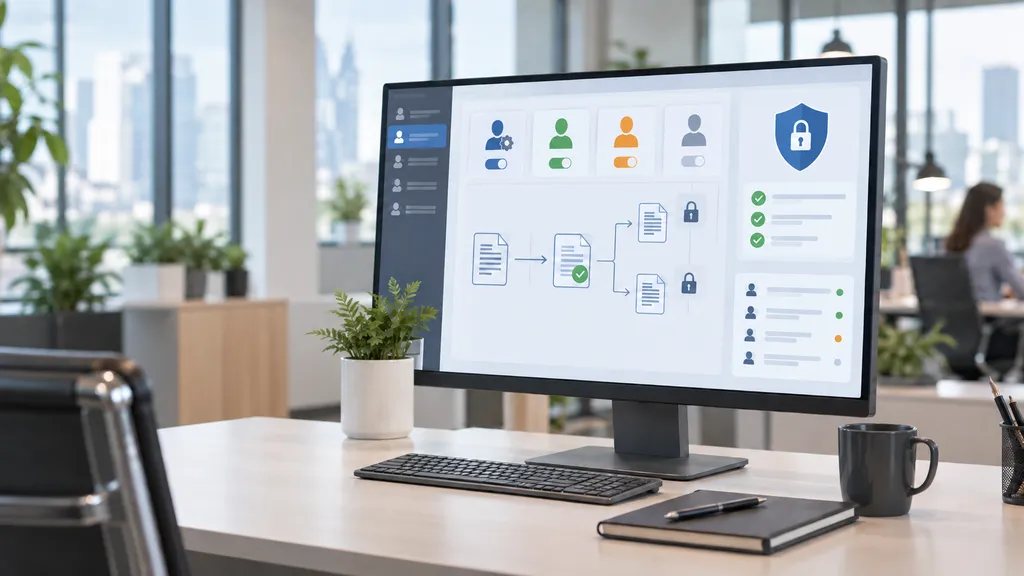
A company’s electronic documents may contain contracts, financial information, personnel data, internal orders, and other information that does not need to be visible to every employee. That is why electronic document management security begins not only with technical protection, but also with proper distribution of permissions.
A well-configured electronic document management system should give each user exactly the level of access they need for their work. An accountant does not need to view all personnel documents across the company, an ordinary specialist does not need access to management contracts, and an employee in one department does not need to see internal materials belonging to another division.
Define Roles Before Individual Users
A common mistake is to assign permissions manually to every employee. While the company is small, this approach may seem convenient, but as the workforce grows, it quickly becomes difficult to manage.
It is more practical to define roles first: for example, department employee, head of department, accountant, lawyer, human resources specialist, director, or administrator. A permitted set of actions can then be established for each role.
EdoLine supports work with the organizational structure, departments, positions, and employee roles. This makes it possible to associate access not only with a specific person, but also with their position within the corporate hierarchy.
Separate Document Viewing from Actions
Access to a file does not automatically mean the right to edit or sign it. When designing permissions, it is useful to determine separately who may:
create documents and upload files;
view materials from specific categories;
make changes;
send a document for approval;
approve it or return it for revision;
sign it with an electronic signature;
access archived materials.
In this way, electronic document management configuration becomes part of the company’s business logic. For example, a manager creates a contract, a lawyer reviews its terms, the finance department approves the amount, and signing authority remains with an authorized executive only.
Why Fewer Permissions Can Be Safer and More Convenient
Information security uses the principle of least privilege: users are given only the permissions they need to perform their responsibilities.
This reduces the risk of accidental deletion, modification, or disclosure of information and, at the same time, simplifies the interface for employees. The fewer unnecessary sections and functions a user sees, the easier it is to focus on their own tasks.
It is particularly important to review permissions when an employee moves to another department, changes position, or leaves the company. Document accounting should remain connected to the organization rather than depend on the personal email account or computer of a particular employee.
Why an Activity Log Is Important
Even with well-designed access controls, it is important to understand what happened to a document after it was created. EdoLine provides an action log and a history of work with documents. The system makes it possible to record process participants and the stages through which documents pass.
Such a log helps determine who performed a particular action, which stage the document is currently at, and where a delay occurred. This is useful not only for security, but also for analyzing working processes. For this reason, document workflow automation should include more than digital storage. It should also provide a transparent system of responsibility.
Access Rights Should Be Reviewed Regularly
A one-time configuration is not enough. A company evolves: new departments appear, responsibilities change, and new document types and routes are introduced. The permissions model should evolve together with them.
That is why document management implementation should ideally be accompanied by periodic role reviews: who has unnecessary access, who lacks required functions, and whether permissions still correspond to the current organizational structure.
If a company is choosing electronic document management for business in Tashkent, it is worth defining not only approval routes, but also the rules governing access to information. Clearly distributed roles help protect corporate data, preserve the history of decisions, and make employees’ daily work easier to understand.