Working with suppliers, clients, and partners is often slowed down not by the content of documents, but by the exchange process itself. A contract may already be prepared, but it still needs to be sent, reviewed, revised, approved again, signed, and stored as a final version. If some stages take place by email, others in messengers, and some on paper, it becomes easy to lose the current file or overlook a delay.
Electronic document management helps build a single process from document preparation to signing and archiving. At the same time, electronic document management with counterparties does not replace a company’s internal procedures, but connects them with external interaction.
How a Document Moves Between a Company and a Counterparty
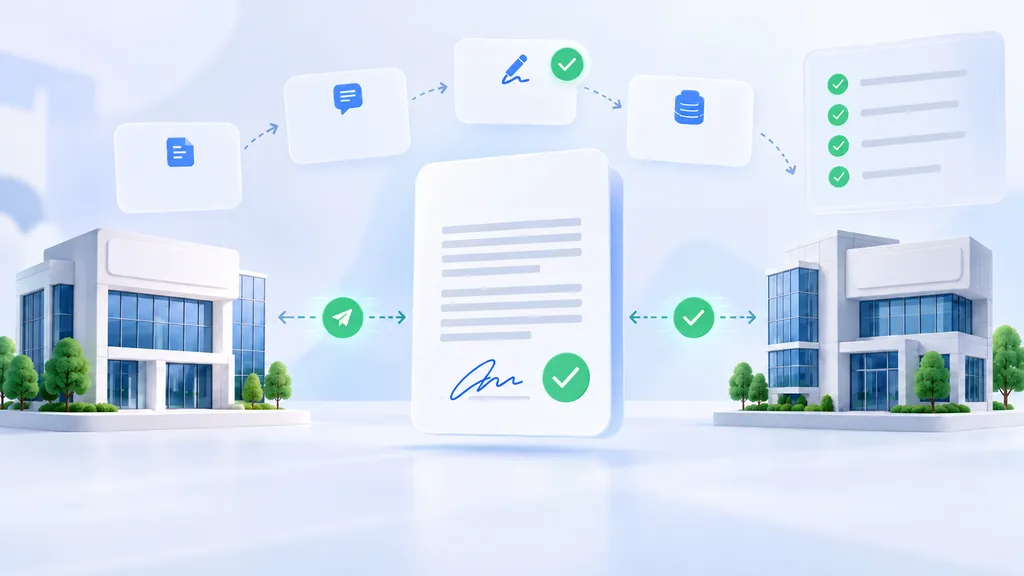
For a standard contract, the sequence may look like this:
preparation of the draft and internal review;
sending the document to the counterparty and receiving comments;
approval of the final version;
signing by authorized representatives of both parties;
storing the final version in the archive;
monitoring further actions, such as the contract term or receipt of an act.
This approach reduces the likelihood of working with different versions of the same file. An electronic document management service helps preserve the history of document movement and makes it possible to understand which stage the document is currently at.
Why Status Control Is More Important Than Sending Speed
A file can be sent within seconds even without electronic document management. The main value of the digital process lies elsewhere: the company understands what happens after the document has been sent. It may be waiting for approval by the partner, a manager’s signature, or revision. If the status is visible to process participants, the responsible employee does not need to constantly request updates manually.
This is especially useful when a company works with a large number of contracts and acts. If document management in 1C or another accounting system needs to be connected with electronic document management, it is important to define in advance which data should be exchanged between the systems. Integration is justified where it eliminates repeated data entry and unnecessary manual operations.
What to Do If a Counterparty Has Not Yet Switched to Electronic Document Management
The transition rarely happens simultaneously for all partners. One company may already use electronic signatures and a digital archive, while another continues to exchange conventional files or paper originals. In such a situation, there is no need to stop the implementation of electronic document management. Counterparties can be divided according to their level of readiness, and suitable scenarios can be gradually transferred into digital format.
The company can already carry out internal preparation, approval, and control within the system, while the external stage can temporarily be organized in a way that is accessible to the specific partner. The most important thing is to establish clear rules: where the final version is stored, who is responsible for receiving the signed document, and how completion of the process is recorded.
Interaction History Becomes Part of Corporate Memory
When work is organized through email, a significant part of the context remains in personal correspondence. After a manager changes, it may become difficult to restore which version of the contract was approved and why certain terms were accepted. Electronic document management helps preserve not only the document itself, but also its path. This reduces dependence on individual employees and makes interaction with partners more consistent.
If a company needs an electronic document management service, it is worth evaluating not only the possibility of signing a file, but also document routes, status control, archiving, access rights, and integrations. A well-configured electronic document management system for business in Tashkent should reflect real relationships with counterparties and allow digital exchange to develop gradually.