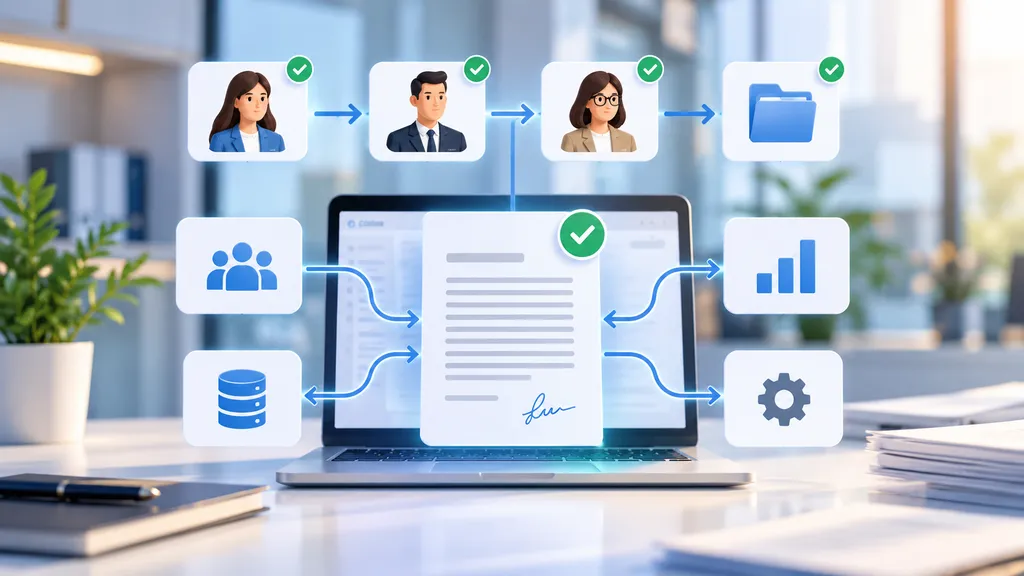
To make the approval process faster, it is not enough to simply move documents from folders and email into an electronic format. If the existing chain is transferred into a system without reviewing roles and stages, employees will still have to wait for one another. Effective document workflow management begins with asking who actually needs the document, what decision each participant is expected to make, and where their responsibility ends.
The route may differ for each type of documentation. That is why document workflow at an enterprise is better structured around real business scenarios rather than built as one long scheme for every possible case. This is the approach our team recommends, and the results of five years of platform operation fully confirm its effectiveness.
Sequential or Parallel Approval: Which Route Should You Choose?
A sequential route means that the next participant receives the document only after the previous stage has been completed. This approach is suitable when one specialist’s conclusion determines what happens next. For example, after a legal review, a contract may be sent to the finance department and then to management.
With a parallel scheme, several employees receive the document at the same time and independently complete their part of the review. For example, a contract can be reviewed simultaneously by a lawyer, a finance specialist, and a subject-matter expert if their conclusions do not depend on one another. Online document approval reduces waiting time between stages, but it is important to determine in advance who makes the final decision.
Both principles can be combined within a single route. For example, specialized departments may first work in parallel, after which the document is sent to a manager for final approval. An electronic document management system makes it possible to define such a sequence depending on the document type and employee authority.
Five Mistakes That Turn Approval into Bureaucracy
Even a well-functioning system will not fix a process if unnecessary actions are built into it. Delays arise when approval routes gradually become overloaded with checks whose necessity is no longer reviewed. When configuring document workflow, five common problems should be examined:
an excessively long chain — stages that do not affect the substance of the decision should be removed or combined;
formal participation of an employee — if an approver does not actually review the document within their area of responsibility, their role should be reconsidered;
lack of deadlines — it is useful to define a processing period for each stage and establish what should happen if a delay occurs;
unclear responsibility — the document should always have a clearly defined person responsible for the next step and for execution control;
repeated verification of the same information — identical data should not be checked at several stages without a specific reason.
This type of analysis helps organize the process before automation begins. If the route is already clear to employees, document workflow automation transfers a functioning process into an electronic environment rather than reproducing a collection of accumulated formalities.
How to Test a Route in Practice Before Launch
It is better to test the route first using one clear scenario. For example, a contract is created by the initiator, then reviewed by a relevant specialist, after which it goes to a manager and finally enters the archive. For a request, the process may be shorter, so the system should take the specific nature of each workflow into account.
During testing, it is useful to go through the entire process from document creation to completion and identify where delays occur. It is worth checking whether notifications are received and whether the approval history is preserved. Employee substitution should also be planned separately. Before launch, the route can be evaluated using several questions:
does the initiator clearly understand who receives the document after it is sent;
does each participant receive only the tasks that fall within their authority;
is there a defined action if no response is received within the established deadline;
is the history of decisions and document changes preserved;
can the current responsible person and document status be identified quickly;
does repeated data entry occur at the next stage.
After testing, the route becomes part of a clear working process rather than an additional obstacle. The electronic archive preserves the history of document movement, while the automated route helps speed up processing.
An electronic document management system in Uzbekistan is useful for a company when the digital route reflects the real responsibilities of employees. Sequential and parallel stages can be used in different parts of the same process if each of them has a clear purpose. The more precisely roles, deadlines, and document transition conditions are defined, the lower the risk that automation will turn into a new form of bureaucracy.